Summary
The Building Safety Act, Awaab’s Law, and the wider post-Grenfell framework are demanding, but they’re not unreasonable. What’s actually breaking compliance programmes across the sector is building safety compliance data: where it lives, how current it is, and whether anyone can produce it when asked.
Ask most property professionals why building safety compliance is hard, and they’ll blame the regulation. Too complex, too new, too much to keep up with. But in reality, they’re pointing at the wrong target.
The Building Safety Act, Awaab’s Law, and the wider post-Grenfell framework are demanding, but they’re not unreasonable. What’s actually breaking compliance programmes across the sector is building safety compliance data: where it lives, how current it is, and whether anyone can produce it when asked.
Recent research from Barbour ABI and GS1 UK backs this up directly. Eight in ten developers aren’t ready to meet post-Grenfell safety law, not because they don’t understand it, but because they can’t operationalise the record-keeping it demands.
Regulation tells you what to know. Data determines whether you actually know it.
The Building Safety Act sets out clearly enough what Accountable Persons and Responsible Persons need to hold: a Golden Thread of safety-critical information, current fire risk assessments, verifiable product provenance, a working Safety Case Report.
None of that is ambiguous. What’s ambiguous, for most organisations, is where any of it actually sits and how it’s maintained.
A fire risk assessment lives in one system. Product certificates sit in a supplier’s PDF, emailed three years ago. HHSRS hazard records are on a spreadsheet a manager inherited from someone who left. None of it talks to the others, and none of it updates when something changes on site.
That’s not a regulatory failure. It’s a data architecture failure, and it’s the one the regulation is now exposing at scale.
Why “we have the information somewhere” isn’t compliance
Under the Building Safety Regulator’s expectations, having the right information isn’t enough. It has to be current, structured, and retrievable without a scramble and this is where most portfolios fail.
Ask a Responsible Person for a complete, up-to-date safety record on a single building, and the honest answer is often “give us a few days.” That gap, between having data and being able to produce it, is where enforcement risk, gateway delays, and remediation costs actually originate.
The Barbour ABI and GS1 UK research points to the same two failure points: chaotic tracking methods and poor product information. Both are data problems dressed up as compliance problems.
Fragmented systems are the default, not the exception
This isn’t a story about a few disorganised organisations. Fragmented building safety data is the industry norm, built up over decades of paper-based handover, unlinked supplier records, and compliance treated as a filing exercise rather than a live operational discipline.
Every stage of a building’s life adds another disconnected source: design documentation, construction records, product substitutions, statutory inspections, legionella monitoring, tenant-reported hazards. None of these systems were designed to talk to each other, because until recently, nothing required them to.
The Building Safety Act changed that requirement overnight. Most organisations’ data infrastructure hasn’t caught up.
Treating compliance as a data problem, not a paperwork problem
The organisations coping well with post-Grenfell regulation aren’t the ones with the best legal interpretation of the Act. They’re the ones that stopped treating safety information as paperwork and started treating it as structured, connected data.
That means one system of record instead of five disconnected ones. Product data linked to the specific building element it’s installed in, not a generic spec sheet. A Golden Thread that updates in real time, not one reconstructed under audit pressure.
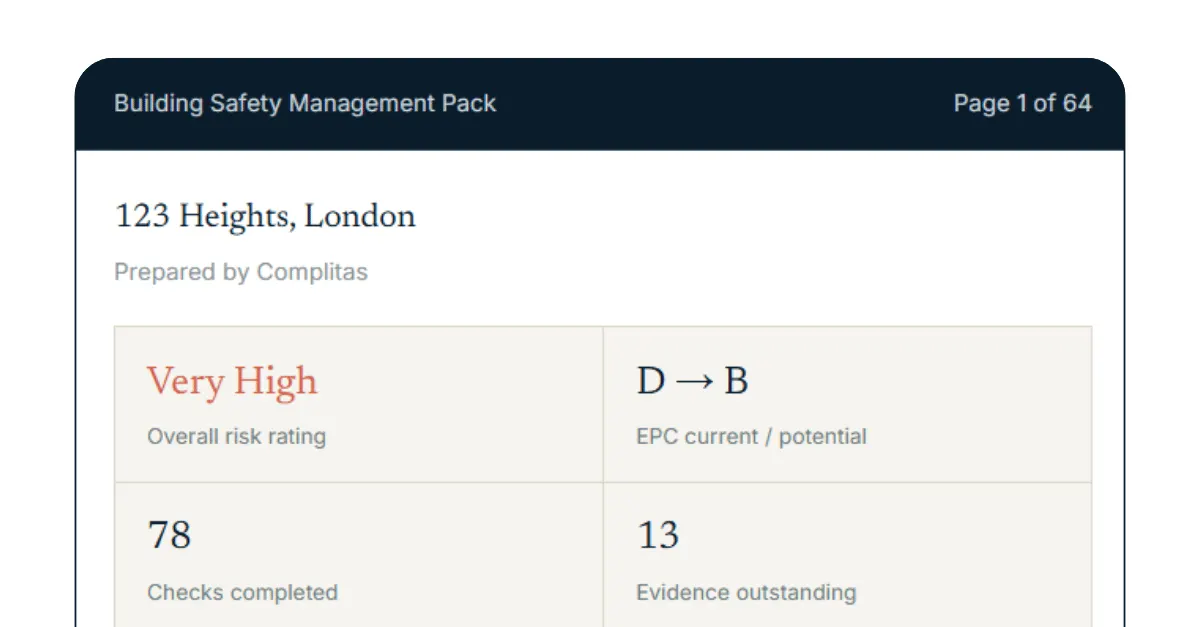
This is precisely where Complitas operates. Purpose built to give Accountable Persons and Responsible Persons a single source of truth for safety-critical data, so compliance is a live state, not a periodic scramble.
Struggling to see your safety data as a single picture? Talk to Complitas about bringing it together.
Make your buildings audit-ready
Complitas keeps every check, certificate and owner in one live record. Sign up and get started in minutes.